
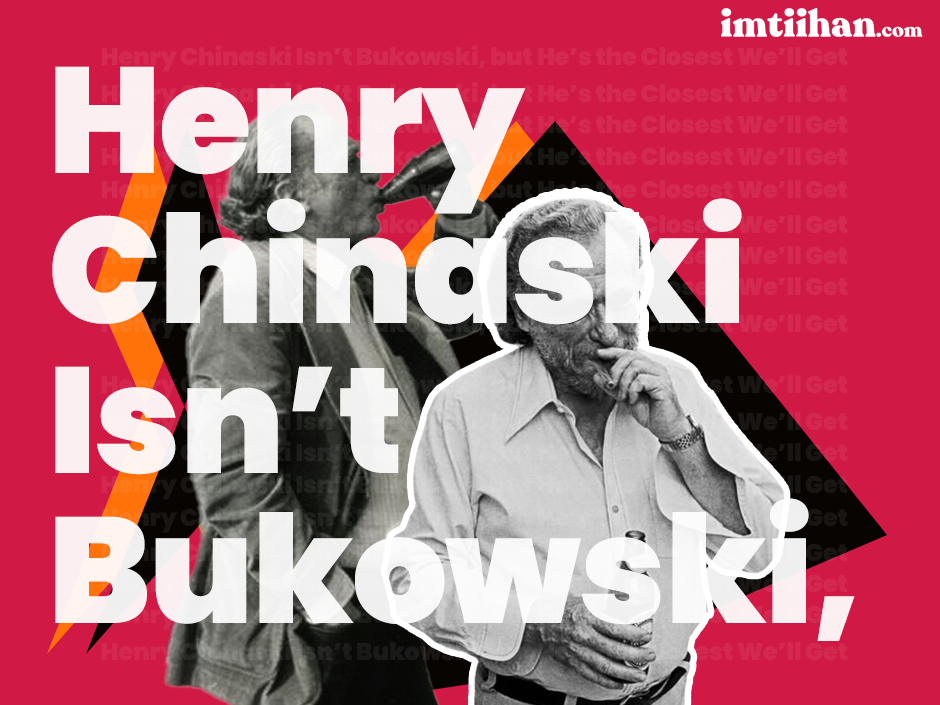
Charles Bukowski built a literary identity on endurance, bluntness, and an almost professional outsider status. To read him is to enter a world where formality is a pretense and survival is a daily negotiation. Central to that world is Henry Chinaski, the recurring alter ego who functions as a living argument for Bukowski’s aesthetic: life and art are one and the same, truth is coarse, and literary decorum is often a lie. Seen from a journalist’s vantage, Chinaski is not merely a character. He is a deliberate instrument through which Bukowski tests the limits of realism, autobiography, and cultural dissent.
Bukowski’s language is simple, often crude, and insistently candid. That stylistic minimalism is not an absence of craft. Instead it is a program. By stripping away ornament, Bukowski forces attention onto behavior, appetite, failure, and the small violences of ordinary life. Chinaski’s world is a sequence of short, hard scenes: menial work, ephemeral sex, recurrent drinking, the stubborn refusal to adapt to middle class rites. This is not romanticism. It is tactical realism, a refusal to prettify suffering or to translate it into the consolations of redemptive narrative.
The political and cultural edge of Bukowski’s work comes from how Chinaski measures value. He treats consumerism and artistic commodification as moral and aesthetic betrayals. In novels such as Post Office and Factotum, work is not a path to dignity. It is a trap that numbs language and imagination. Chinaski’s contempt for the rituals of professional success exposes a larger critique: institutions that promise merit often reward conformity instead. For many readers this stance reads as liberation. For others it reads as willful contrarianism. Both readings are useful because they reveal why Bukowski continues to provoke.
Yet Chinaski is not a hero in a classical sense. He is defensive and frequently disagreeable. He mistreats women and neighbors. He gorges on drink as if numbness were a strategy. These traits complicate any simple claim that Bukowski was a moral teacher. If anything, Bukowski used Chinaski to dramatize contradiction: he admired individual freedom but often failed at sustaining reciprocal care. That failure is not a flaw to be papered over. It is the point. Bukowski stages an ethics of survival that does not guarantee virtue, only a stubborn refusal to apologize for one’s voice.
A central question about Bukowski is how much of Chinaski is autobiography and how much is invention. Bukowski himself invited that confusion. His letters and interviews oscillate between confession and self-mythologizing. He insisted his poems were scarcely fictional, while conceding the novels flirted with both fact and fabrication. The result is a body of work that sits productively between memoir and fiction. Chinaski functions as a filter that shapes raw memory into a literary claim about what it means to remain unassimilated in postwar America. This in-between quality helps explain Bukowski’s broad if contentious appeal. His prose and poems circulate in unexpected places. Prisoners, blue collar workers, and students alike have claimed his lines because his idiom feels immediate and unvarnished. That popularity complicates cultural dismissals that reduce him to shock value. Bukowski’s readership is not simply drawn to obscenity. They respond to a persistent witness who refuses the consolations of middle class narrative and insists on the aesthetics of survival.
Still, the value of Bukowski’s work must be qualified. His frankness about sex and gender often lapses into crude generalizations. Moments in his work that read as honest reportage about desire sometimes slide into dehumanizing caricature. If Bukowski’s aim was to document a raw interior, he occasionally did so at the expense of empathy. Readers who admire his unfiltered voice must also confront the social costs of that voice, especially in a literary climate that increasingly scrutinizes how representation shapes real world attitudes.
Bukowski’s stance toward literary art is itself a kind of manifesto. He saw aestheticism as a betrayal when it became a market. For him, writing should be the vehicle of an individual’s unmediated experience. Chinaski, then, is both avatar and critic. He embodies the artist who refuses literary fashion, who lacks patience for academic refinement, and who believes that art must risk cruelty as well as clarity. That posture explains why critics oscillate between calling Bukowski a brilliant chronicler of marginal life and labeling him a reactionary troubadour of vice.
Measured as cultural practice, Bukowski’s greatest legacy may be his insistence that literature can be stubbornly utilitarian. He believed the writer’s task is to render what is lived and to resist commodification. That belief gives his work its energy and its contradictions. Chinaski does not offer consolation. He offers a persistent, sometimes infuriating reminder that honesty in art can mean refusing polite sympathy and accepting the consequences of that refusal.